
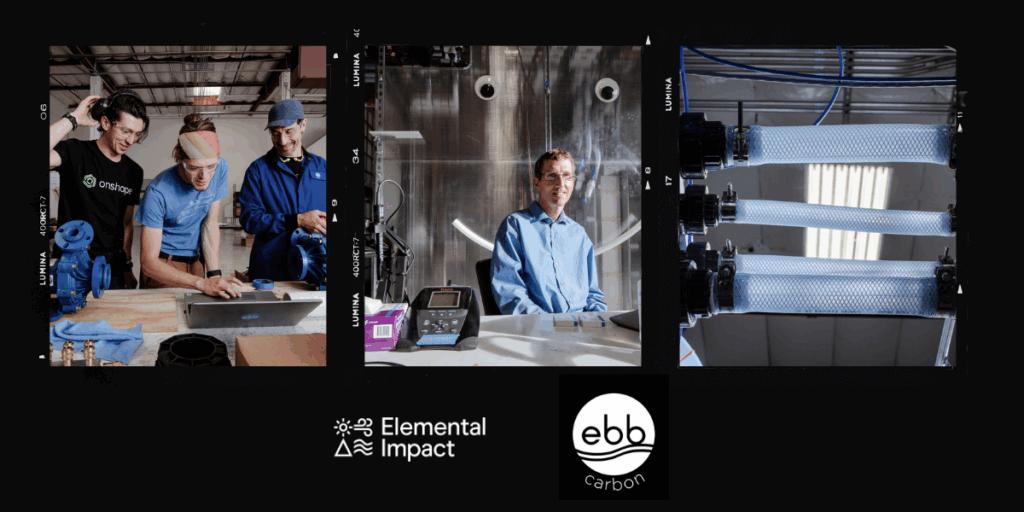
In Washington’s Port Angeles Harbor, Ebb Carbon just launched Project Macoma, a first-of-a-kind project designed to remove carbon dioxide from coastal waters while restoring balance to ecosystems disrupted by ocean acidification.
Ebb Carbon’s dual-purpose technology addresses the twin problems of too much CO₂ in the air and too much acidity in the ocean. By tapping into the ocean’s vast carbon storage capacity, Ebb is delivering one of the most scalable and cost-effective carbon removal solutions on the market, while benefiting coastal communities that depend on healthy marine ecosystems. It’s a major step forward for ocean-based carbon removal, and the first project of its kind to receive a Clean Water Act permit.
Over the course of the project, Elemental supported Ebb Carbon in developing a framework for local engagement, advancing a major offtake agreement with Microsoft, developing a blended financial strategy for infrastructure development, and strengthening their global expansion strategy. We recently spoke with Ben Tarbell, CEO of Ebb Carbon about the significance of Project Macoma, the lessons learned, and what it means to build genuine partnerships with local and Tribal communities.
For those who aren’t familiar, can you share what Project Macoma is and why it’s such a significant step for Ebb?
Project Macoma is our next major scale-up—a 5x increase from previous deployments—with the capacity to remove 500-tonnes of CO2 from the atmosphere each year. A system like this lets us test and refine our ocean alkalinity enhancement technology at a size that just isn’t possible in the lab. It’s both a scientific and a commercial milestone for Ebb, demonstrating how ocean-based carbon removal can restore balance to coastal ecosystems affected by acidification.
The project is located in the historical native area of the Lower Elwha Klallam Tribe, where extra acidity in the water has long disrupted marine life and habitats. By removing oceanic acid and restoring pH levels, we’re working to counteract those effects and contribute to healthier coastal waters.
“Elemental’s support enabled Ebb to move from a promising pilot to a permitted and operating, community-backed project. This collaboration not only advanced Ebb’s mission to remove CO₂ from the atmosphere, but also created lasting benefits for the Port Angeles community and set a model for climate infrastructure worldwide.” – Ben Tarbell, CEO of Ebb Carbon
Ebb recently secured the first-ever Clean Water Act permit for an ocean carbon removal project—a huge achievement. What did that process teach you?
Getting that permit was a multi-year effort that reinforced one of our core philosophies: go slow to go far.
In a field where there’s skepticism about interventions in the natural world, we’ve learned that trust and credibility are everything. That means taking time to engage early and meaningfully with every stakeholder—from tribes to local communities to state agencies—and being flexible enough to adapt our plans based on what we hear. There were things we didn’t originally plan to do that we ended up incorporating because they mattered to our local partners. For example, we worked with the Lower Elwha Klallam Tribe to co-develop salmon and mussel studies to define safe operating bounds for marine life, which were ultimately incorporated into our Ecological Safety Methodology and an essential component of our Clean Water Act permit application. Our willingness to listen and align made the difference between progress and roadblocks.
The same deliberate approach is now helping us build confidence beyond the permitting process. Last year we announced a 10-year offtake agreement with Microsoft to remove up to 350,000 tonnes of CO₂ using Ebb’s technology—the largest marine carbon dioxide removal commitment to date. It’s a powerful validation that taking the time to get the science, partnerships, and safeguards right can unlock trust at every level—from local communities to global partners.
Can you walk us through Ebb’s engagement with the Lower Elwha Klallam Tribe and what you’ve learned from that partnership?
Our first meeting with Chairwoman Charles set the tone. We told her, “If you don’t want us here, tell us.” That openness gave the Tribe genuine veto power and created space for honest dialogue. From there, we worked side-by-side to understand their priorities and the ecological context of the area.
The Tribe brought deep local knowledge that improved our safety approach and informed the design and monitoring of the project. Their support wasn’t just invaluable, it was essential for the permit itself. And beyond that, it shaped how we think about collaboration: every partner, from the port to the marina to the Sierra Club chapter, has a different timescale and stake in this work. The Tribe has been here for tens of thousands of years and will be here for tens of thousands more. Keeping that long view in mind has grounded how we operate and how we define success.
See more projects taking shape. Follow our First of a Kind, Next to Scale series for stories from the teams building the next chapter of climate innovation.
 Sign up for our monthly newsletter