

I could not be more excited to celebrate Elemental’s first investments of 2026 and the first as Managing Director of Portfolio and Investments. After close to five years at Elemental, it’s more clear today than ever that organizations like Elemental have such a critical role to play in helping breakthrough solutions reach the market.
The environmental movement is at an inflection point. There’s a growing gap between what society urgently needs and what our legacy institutions are built to do. To meet this moment, it’s essential that we evolve from a movement solely focused on protecting our planet to one that also proactively builds the systems, infrastructure, and industries that will make our world better.
That is the work we are committed to at Elemental. We are obsessed with helping entrepreneurs scale critical climate solutions to meet this need. That sense of urgency is shaping how we show up as investors. Historically, we backed companies once a year in annual cohorts. Going forward, we are using a rolling application cycle, which means we will be investing in companies as we find the right entrepreneurs, with the best teams, building important technologies that need catalytic support. This approach reflects the pace of the market, the needs of founders, and the momentum required to scale climate solutions now. Get ready to hear more from us as we make more, pivotal new investments.
With that, I am thrilled to announce Elemental’s first investments of 2026: BurnBot and Pono Energy, alongside follow-on investments in Bedrock Energy and Molg. These bold companies are not only pushing boundaries every day; they are building and deploying the solutions that this moment demands. We are proud to be on this journey together.

Amplifying Wildfire Prevention: Why We’re Investing in BurnBot
BurnBot is tackling one of the most urgent climate challenges of our time: catastrophic wildfires. Extreme wildfire activity has more than doubled globally in recent decades, fueled by hotter, drier conditions that are making fire seasons longer and more dangerous. Globally, carbon emissions from forest fires have seen a 60% increase since 2000.
What makes BurnBot stand out is its focus on prevention—addressing this challenge with a vertically integrated approach that combines strategic planning, robotics, fuels reduction, prescribed fire, and mapping to remove hazardous vegetation up to 10 times faster and at roughly half the cost of traditional hand crews. While many wildfire solutions help detect or monitor fires, BurnBot is focused on reducing the hazardous vegetation that allows small fires to become catastrophic ones.
What Sets Them Apart: Scalable Wildfire Prevention Paired With Local Workforce Capacity
BurnBot’s solution has the potential to build a repeatable model for wildfire resilience. Its “halo of protection” model treats landscapes around communities to slow or stop advancing fires before they cause widespread damage. With the right financing and partnerships, this approach could become a replicable blueprint for wildfire resilience across the American West and beyond.
Delivering the work at scale requires people. BurnBot’s projects rely on local workforce and tribal partnerships to carry out fuels reduction and prescribed burns, creating jobs and long term capacity. In 2025, the company added 59 employees while expanding its treatment footprint by over 4,100 acres.
With Elemental’s investment, BurnBot will demonstrate and scale this model in new regions, starting with Washington State, building both ecological resilience and local economic opportunity.
“The scalable way to stop destructive wildfires is to remove the conditions that allow them to ignite and spread. BurnBot is focused on doing exactly that—scaling land management with robotics and prescribed fire while building local workforce capacity. With Elemental’s support, we’re accelerating a model that can be replicated across the West to protect communities, infrastructure, and natural ecosystems.” – Dr. Anukool Lakhina, Founder & CEO of BurnBot
Quick Highlights
-
- Robotics-Enabled for Speed and Scalability: Their robotic systems can treat hazardous vegetation up to 10 times faster and at roughly half the cost of traditional hand crews.
- Community Protection: There are more than 1,000 towns at risk of urban wildfires in the U.S. “Halo of protection” zones help safeguard communities in wildfire-prone landscapes.
- Climate Impact: By removing excess fuels and conducting controlled burns, BurnBot prevents significant CO2 and particulate emissions associated with high-intensity wildfires. Globally, carbon emissions from forest fires increased 60% between 2001 and 2023.

Rooted in the Islands: Why We’re Investing in Pono Energy
Aviation is one of the hardest sectors to decarbonize, and it matters deeply in island economies like Hawaii where aviation connects communities and drives tourism. In 2017 alone, the carbon footprint of visitors flying from the Western U.S. was the equivalent of driving a car around the equator 225,000 times.
Pono Energy is working to address this challenge by cultivating camelina, a versatile crop that can be refined into sustainable aviation fuel (SAF) and renewable diesel. Because it grows well in Hawaii’s climate and fits into relatively short growing cycles—about 60-100 days—camelina offers a way to produce local fuels and reduce the state’s reliance on imported oil.
What Sets Them Apart: Local Energy Led by Dynamic Partners
We are excited by Pono Energy’s place-based approach and the team behind it. Spun out from Pono Pacific, a well established conservation organization and long-time Elemental partner, Pono Energy is committed to building a more self-sustaining future for Hawai’i. By cultivating purpose-grown energy crops on underutilized or fallow land, the company is creating new revenue streams for farmers while producing feedstocks for low-carbon fuels.
Through partnerships with Alaska Airlines and Par Hawaii, a local refinery, Pono Energy is helping connect local agriculture to local fuel production while bolstering Alaska Airlines’ target to meet net zero carbon emissions by 2040.
“We’re honored to partner with Elemental Impact and work alongside Alaska Airlines and Par Hawaii to take meaningful steps toward strengthening Hawaiʻi’s energy security while creating new opportunities for our agricultural community. This partnership shows what’s possible when local agriculture, energy, and aviation come together—we can grow fuels here in Hawaiʻi, reduce dependence on imports, and build a more resilient, self-sustaining future.” – Chris Benett, VP of Sustainable Energy Solutions at Pono Energy
Quick Highlights
-
- Local Energy Security: In Hawaiʻi, air transportation accounts for the largest share of petroleum use—more than ground transportation or electricity generation. Producing plant-based oil in Hawaiʻi reduces reliance on imported fossil fuels.
- Agricultural Revitalization: Camelina creates new revenue streams for farmers as a fast growing rotational crop. The crop can grow in relatively short cycles—about 60–100 days in Hawaiʻi’s climate
- Decreasing Import Dependence: Hawaiʻi currently imports roughly 16 times more energy than it produces, underscoring the need for locally rooted fuel solutions.
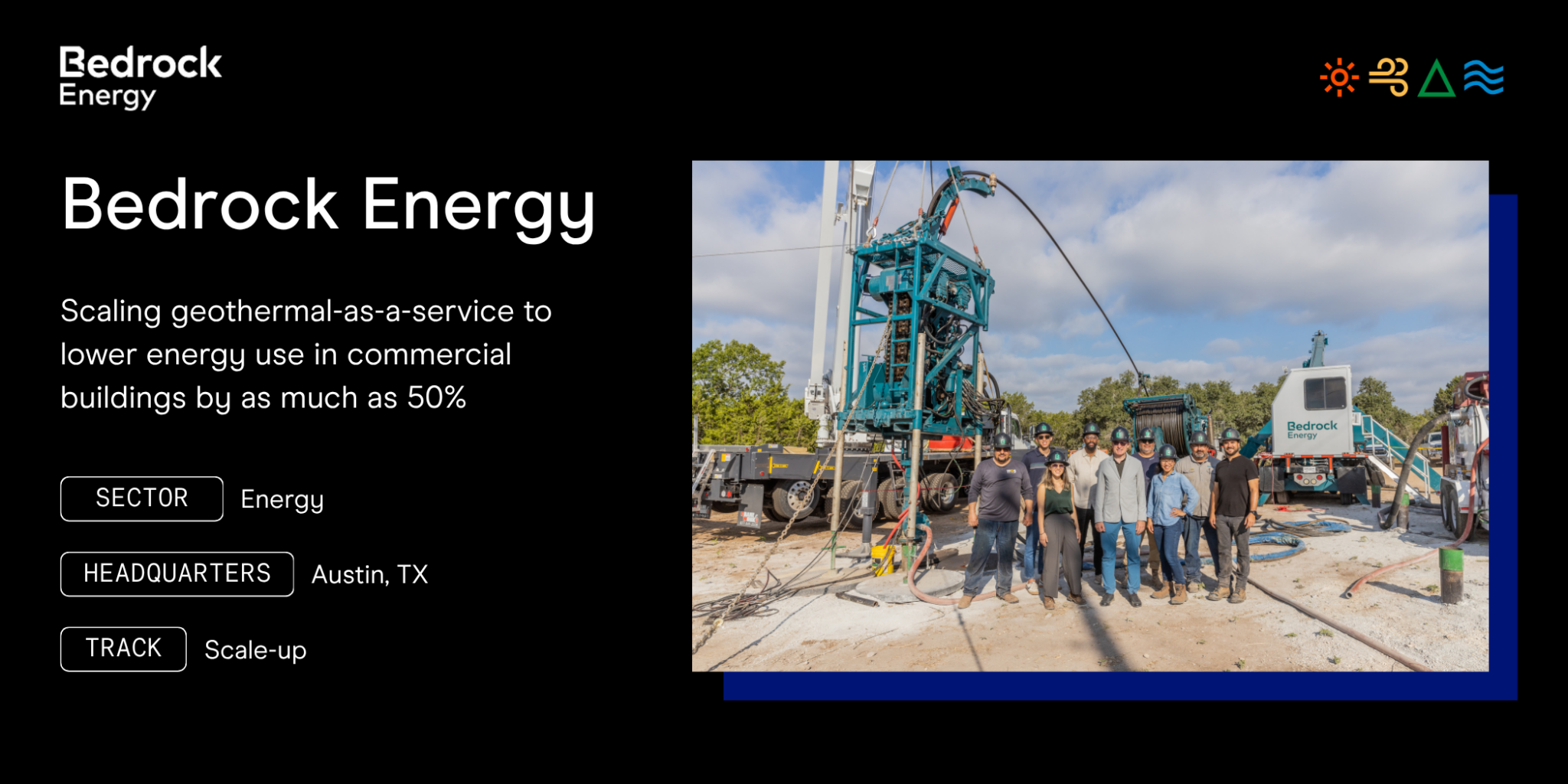
Grounding Innovation: Why We’re Doubling Down on Bedrock Energy
Some of the most stubborn emissions come from the massive, unassuming industrial and commercial hubs we pass every day. These buildings play an essential role in the economy, yet many still rely on aging, fossil-fuel-reliant HVAC systems because the cost of switching is steep.
Bedrock is changing that by introducing Geothermal-as-a-Service (GaaS). Instead of asking building owners to fund and manage a major infrastructure upgrade themselves, they can lease a reliable clean thermal energy resource from Bedrock with the same ease and simplicity as they would for electricity through a solar PPA. It’s clean, it’s 24/7, it lowers energy use by as much as 50%, and can free up 1-5MW of power capacity per site.
What Sets Them Apart: Standardizing Geothermal to Unlock Scale
Bedrock’s technology has the potential to make geothermal repeatable and scalable. By creating a model that can be deployed across many properties, the company helps commercial, multi-residential, and public-sector buildings adopt cleaner heating and cooling. Since our initial investment in 2023, Bedrock has begun proving that model in the field, from its first project in Austin, Texas to a much larger district installation in Hayden, Colorado.
Now, funded by an Elemental D-SAFE, Bedrock is working with major logistics property owners to prove the model across entire real estate portfolios, with the potential to expand across more than one billion square feet of industrial real estate, approximately the size of Miami, FL. The company is also expanding into multi-family and institutional buildings in states like Colorado and New York, where favorable policies and strong geothermal resources align, helping galvanize a national market for next-generation geothermal solutions.
As deployment grows, so does the workforce required to build it. Bedrock is helping train a new generation of drilling crews and engineers—including nearly a dozen former oil and gas employees—creating pathways for workers from fossil-fuel-adjacent industries to transition into specialized geothermal roles.
Elemental has been an incredible value-add partner to Bedrock, helping us translate early demonstration success into commercial momentum, community and policy engagement, and organizational growth. With this new investment, they are again backing us at an inflection point as we prove a scalable path for geothermal deployment in enterprise real estate portfolios through geothermal-as-a-Service.” – Joselyn Lai, Co-founder & CEO of Bedrock Energy
Quick Highlights:
- Grid Resilience: By shifting thermal loads underground, Bedrock can reduce a building’s grid reliance by roughly 25-60%.
- Cleaner Local Air: Replacing gas-fired boilers can cut local pollutants in the neighborhoods surrounding these industrial hubs by more than 80%.
- Lower Heating Costs: Bedrock delivers thermal energy that is 25-50% cheaper than using traditional electric or gas heating.
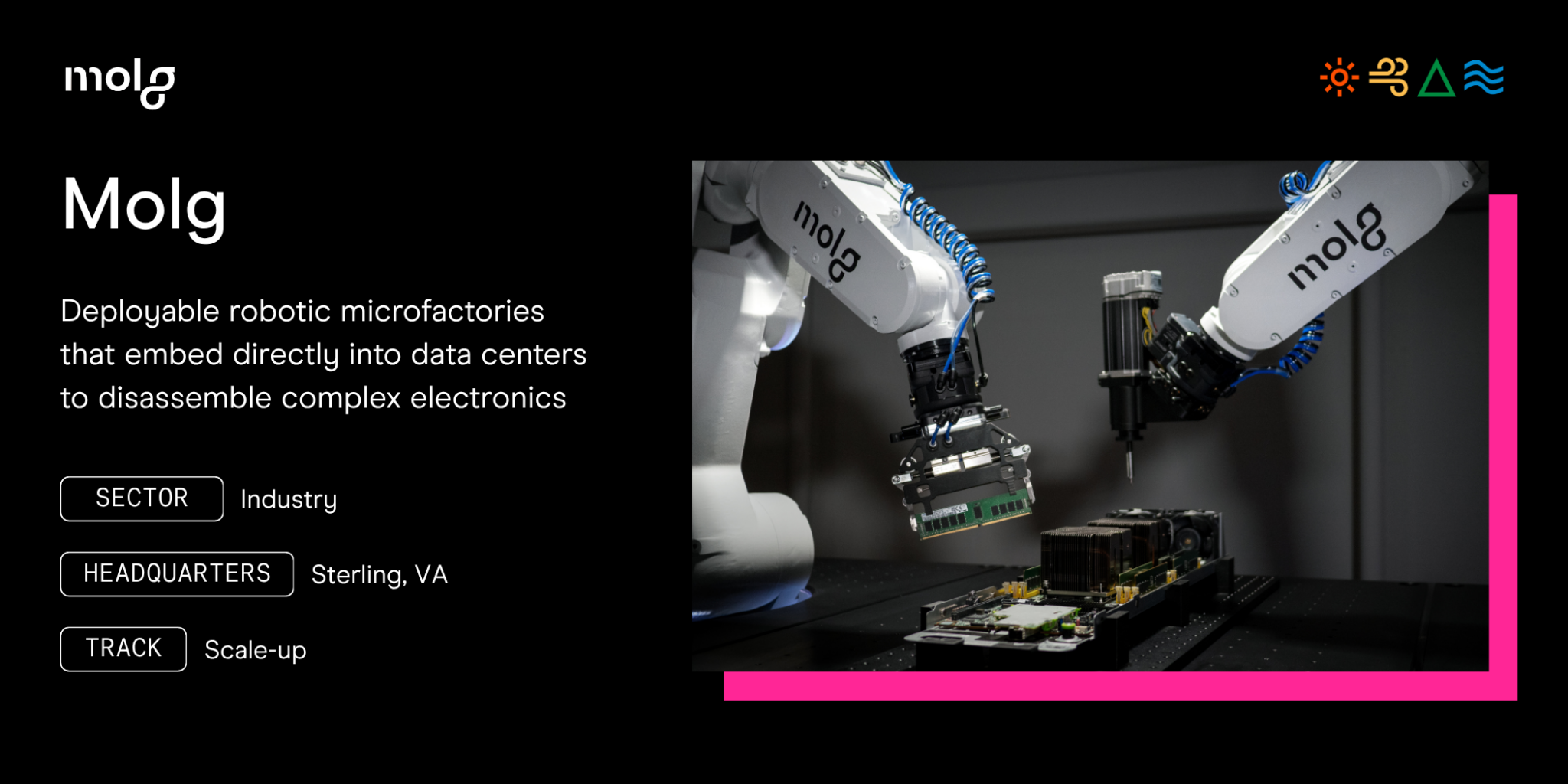
Solving E-waste with Circular Manufacturing: Why We’re Doubling Down on Molg
Electronic waste is one of the fastest-growing waste streams in the world: 62 million tonnes of devices are discarded each year, yet only about 22% are formally recycled. That pressure is rising as artificial intelligence accelerates demand for data centers, where servers often need to be replaced every four to six years, compounding the volume of high-value electronics entering the waste stream.
Molg is tackling this challenge with a new approach to circular manufacturing. Their deployable robotic microfactories autonomously disassemble complex electronics—like data center servers —at scale, allowing them to embed directly into hyperscaler facilities to improve the economics of returning materials to the supply chain. At the same time, the company works upstream with manufacturers, like HP, Dell, and ABB, to design products for disassembly and automation from the start.
What Sets Them Apart: Bringing Circular Manufacturing into Data Centers
What stands out is Molg’s focus on real-world deployment. At a moment when AI is driving major economic growth, the company is expanding its microfactory model and developing new products, like OriginMark, tailored to these environments. OriginMark, is an open standard labeling and tracing tool for the smaller components that make up complex electronics. This increased visibility enables greater accountability for data center operators and makes decommissioning products easier, driving more reuse and remanufacturing.
Since our initial investment in 2021, Molg has made strong progress toward making circular manufacturing deployable at scale. The company has built partnerships with leading hyperscalers while advancing its microfactory robotics and design-for-circularity software to enable more efficient disassembly and recovery of valuable materials.
Elemental’s partnership has been transformative for Molg. From helping us sharpen our commercial strategy to unlock major customers, to now providing capital to accelerate critical R&D around traceability, we would not be where we are today without their deep, hands-on support.” – Rob Lawson-Shanks, CEO & Co-Founder of Molg
Quick Highlights
- Growing E-Waste Challenge: Tens of millions of tonnes of electronics are discarded each year, yet only 22.3% of global e-waste is formally recycled.
- Recovering Lost Materials: More than $62 billion in critical minerals and precious metals remain unrecovered in discarded electronics annually.
- Strengthening Supply Chains: Recovering materials domestically can help reduce reliance on geopolitically sensitive critical mineral supply chains.
 Sign up for our monthly newsletter